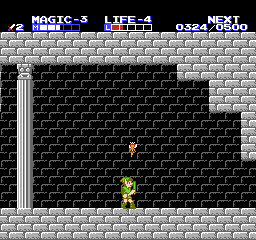
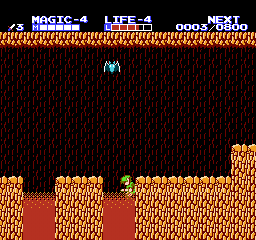
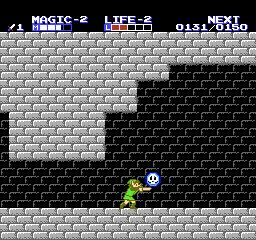
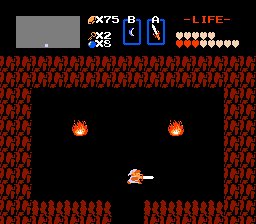
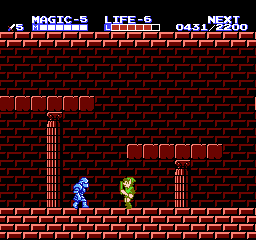
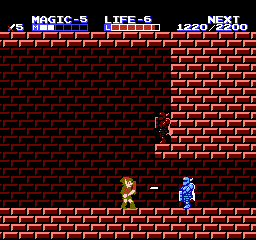
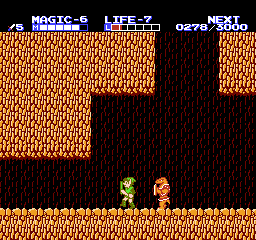
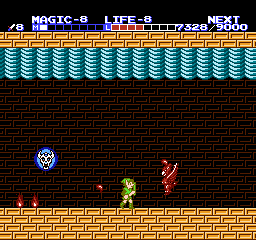
Back during the NES days, there weren't any real 'series' of games. No game
developer was going to take an Atari game and go "why not make sequel that
pile of horse shit!" Thus, game developers were a bit more, let's just say,
'experimental' or 'creative' with their games. Of course, we now call that
'risky', which must now be crushed. Coming fresh off of their ground-breaking
successes of Legend of Zelda, Hiroshi Yamauchi and Shigeru Miyamoto decided
(probably while drunk at a Japanese strip joint) that the best way to follow
perhaps the greatest game ever made was a game completely different then what
came before. It will also feature the additional bonus of being able to cause
seizures.
A game so different that everyone, even Nintendo fanboys, will hate it. And
that game will be the only game in the Zelda franchise to ever carry a number
in the title, firmly placing itself in the non-existing Zelda timeline. That
game is Zelda 2: The Adventure of Link.
Too Much Back Story
The story of Zelda 2 it described in a single paragraph if you wait long
enough at the title screen, Zelda has fallen under a sleeping curse, and
unlike in fairy tales, no amount of sexual molestation will wake her up. So
Link sets out to recover the third and final Triforce to wake her up.
The Triforce isn't even named in-game. It's left to the manual to fully
describe the back story, and what a back story it was. A long, boring back
story that was an example of the first rule of Zelda sequels: never have
anything to do with previous Zelda games (until Wind Waker messed that up).
Zelda 2's back story stretched around 9 pages, which was a long back story for
kids back then and even longer for kids today. Even Final Fantasy, which came
with a mega-tome of an instruction booklet (weighing in at around 80 pages)
didn't even have that much back story.
But let's get back to the point. The story picks up several years after Ganon
has been slain, and, well, I'll let the instruction booklet explain how Ganon
could return.
To go into another tangent, Nintendo's censorship was absurd in those days.
When Maniac Mansion was being ported over to the NES, for example, they
removed the SCUMM pennant from weird cousin Ed's room. Because SCUMM is
apparently a really bad word (it was actually the engine that the game was
made on). Actually, it's still there, go and see if you can find it. To allow
the mention of a bloody ritual sacrifice to resurrect a dark lord of evil is
well, pretty amazing. I'll be pointing out other times Nintendo apparently
screws its own rules.
In fact, the Zelda in this game isn't even the Zelda from the first game.
There's no mention of Zelda number 1, maybe she got eaten by a Gohma, or a
Peahat, or maybe she ran off with that guy from Faxanadu. It doesn't matter,
since Link gots a new women now! Oh, wait, the whole sleeping thing, right.
Ahem, because of sleeping curse, Shigeru Miyamoto came up with a good excuse
to never have to think up a new name of the princess that needs to be saved;
since Zelda's brother decreed that every girl of the royal family would be
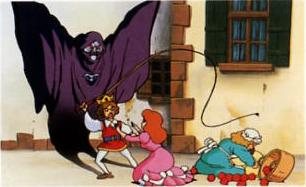
named after her. It was the brother who ordered Zelda to be put to sleep; he
was tricked by a magician to make Zelda tell where the third Triforce is. The
prince, if the illustration from the instruction book is to be believed, was
whipping an innocent townsperson to make Zelda talk (Nintendo screw over #2).
Also, the image of the old king bears a curious resemblance to the King of Red
Lions (human form) from Wind Waker, just like to point that one out.

Now there's a throw-back for long-time Zelda fans.
Pissing Off the Fanbase for the Win!
So, now that we have an epic story line, what we need now is an awesome game
to follow up on. So what if only half the programmers from the first game were
available, this bird was gonna fly! They even had to bring in a new sound
composer, Akito Nakatsuka. Now, Akito Nakatsuka isn't very well known in the
video game business, even today. Some of his other works include ice climbers
and...uh...that brain game that came out for the DS, and I think they asked him to
improve some music for Super Smash Bros Melee. There can't be that much work
for a video game music composer whose only experience is from the 8-bit era.
Which is sad, since the music in Zelda 2 is some of the best and most varied
music on the NES, stacking nicely alongside Castlevania 3 and Final Fantasy.
The music of the palaces would be the aforementioned song put into Smash Bros,
and they didn't even change or add to it. The only difference is that they
used actual instruments to record it. The song itself lasts around a 1:30,
which is pretty impressive since most NES songs only lasted around 30 seconds
before repeating.
Once again, I am distracted. The game-play itself seems to stem from what
other game developers were also doing with their sequels at the time. That the
game must be über-freaking hard. Granted, we aren't talking 'Ninja Gaiden bust
your balls hard,' but it's still harder than the first game. Most of the
game's difficulty comes from four things that many people complain about: the
difficulty in refilling your life bar, the limited number of lives, Link's
pathetically short sword, and the dreaded exp scale.
Hope You Like Killing Things: Refilling the Life Meter
Like other JRPGs, you could recover life and magic in towns. This was
accomplished by talking to lonely housewives and then being invited into their
homes for 'healing'. To recover magic, Link gets invited into to what appears
old men's (but are actually old women's) houses. Trust me; any innuendo you
just thought up about those last couple of sentences is all you.
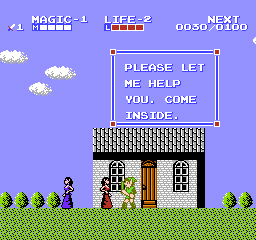
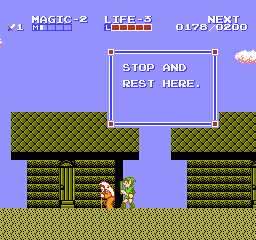
The best method (and most used) is to use the 'LIFE' spell, which takes a
whole lot of magic points and only recovers three boxes of life. At max magic,
you can only cast it twice, and then one of the cheap spells, and then it's
back to the creepy old men, I mean women. Good thing every sixth monster will
drop a magic bottle, capable of refilling one (blue) or all (red) of Link's
magic boxes. So to refill Link's life, you would find some place in the
dungeon were there was an endless stream of monsters, like bits, or bots, or
myus (those spiky things). And then you would kill them, kill them, and keep
on killing them until you were maxed out. Of course, you wouldn't always get a
bottle. Sometimes you would get a point bag that gave you lots of experience
points. And leveling up your life level would refill all of the boxes, but to
rely on that method would be suicide.
So, whatever happened to all of those fairies that enemies dropped in the
first Zelda? They're still around, you can run into them randomly on the
overworld, or in preset locations in both the overworld and dungeons.
However, fairies are far and few between, so most players are stuck, as I just
said, killing the same monster over and over. While there are plenty of these
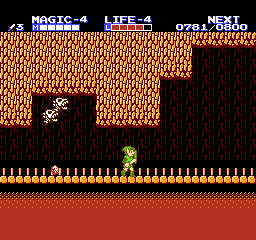
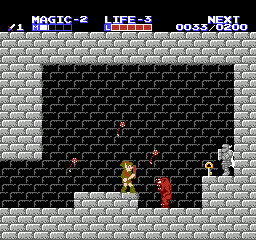
'refueling spots,' as I like to call them, most are boring to use. The picture
below is an example of what people could consider to be a refueling spot, but
only the blue acid drops from the red statue head turn into monsters, and that
happens a little too random for my taste. Also, there's a limit of 3 bots per
screen from these droppers, so you waste way too much time waiting for enemies
to appear.

So, to compare Zelda 2 to Twilight Princess or any new Zelda game, which gives
you 4 bottles that completely refill your massive life meter and (almost) free
to fill up, it's easy to see why people used to the newer Zeldas complain this
one is too hard. It's just very hard to die in newer Zeldas. It's not that
Zelda 2 is very hard, it's just that many people don't want to sit around,
killing the same monster 60 (this is not an exaggeration) times so they don't
screw up, get wasted by the boss, and waste one of their few precious lives.
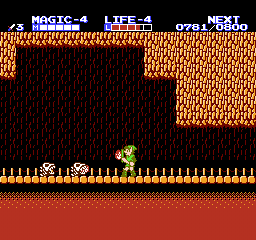
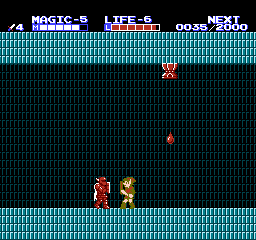
Take a good look at both of those pictures. That monster (myu) gives 5 points
when killed. I gained 415 points while refilling my life and magic bars.
Granted, I got one 50 points exp bag, but that's still 365 points, and
remember, every sixth enemy leaves a bottle. Do the math. I killed that myu
around 78 times. While this is actually nothing to some of the power leveling
required by JRPGs, no one wants this from a Zelda game.
Why did I do it? Because this is what was waiting for me in the next room:

Yes, that's a boss.
At Least He Lives Longer Than That Guy From 'Spelunker'...: the Life System
It would seem odd that people complain about the life system in Zelda 2, since
in every other Zelda game, you only had one life. True, you could put fairies
into a bottle to resurrect Link when he died, but the fairies did not recover
all of Link's life until Ocarina of Time, and you didn't get any bottles in
Link's Awakening. The reason why Zelda 2's life system is screwed up is
because Link can die so easily. Due to Zelda 2 being a mix of a platformer and
a JRPG, the nasty combination of inexperienced players dieing easily and the
heavy punishments for dieing (losing exp) is not handled very well, that is,
not at all. And once you run out of lives and continue, start at the very
first area of the game, instead of at the beginning of the dungeons (except
for the Great Palace).

This is where you start every time you turn the game on, and the exp counter
will reset back down to zero when you run out of lives. Nothing is more
irritating than dieing on your last life with only 50 more points to next
level. Adding to the irritation level, the monsters have been made seriously
stronger. Many minor enemies can take off entire boxes of life, and since Link
only has 8 maximum, he can die very fast. There's also the inconveniently
placed bottomless pits that are common in all platformers, made more annoying
by monsters placed in the right spot to knock you into them.
There were very few 1-ups in this game as well, leaving many people to invent
new swear words, like 'dogaroughagh' (don't ask me how to pronounce that) when
they died.
Insert Witty "Crocodile" DunDee Joke: Link's Sword
Link's sword, which was actually the magical sword from the first game (wow, a
game that carries items over from previous games!), is often described as an
overly large knife. Strike that, just a knife, a short one at that.
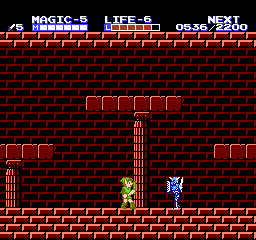
Take a look at that picture, that is the maximum range of Link's sword,
roughly one block length away from his body. The sword also has a poor
vertical range, but I'm still hitting that bubble. As long as it collides with
one pixel of an enemy, it still registers a hit. The main problem with Link's
sword is that when Shigeru Miyamoto designed it, he only took Link's width
into consideration, not his height. In Zelda 1, Link's sword was as big as he
was. This was because Link was only as big as one block, so when Link got
bigger in Zelda 2, people naturally assumed that his sword would get bigger as
well.
This was not the case. On a side note, this somewhat explains why the Master
Sword is so large in both Wind Waker and Twilight Princess.
Mixing Side-Scroller and JRPG: Towns, the Exp Scale, and Really Tough Monsters
Not all of the things taken from the JRPG side of the game was bad, such as
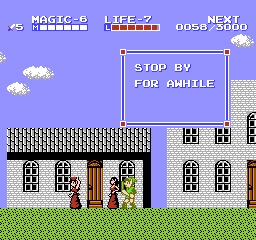
the towns Link could explore. One interesting thing about these towns was
that, unlike other JRPGs, there were people constantly walking through the
area. These people all said about three lines, all along the lines of "I can
not help you." Still, it was nice to see towns filled with people instead of
just seven people you see in new games. There were also monsters in two of the
towns, just to freak players out. I think it would be hilarious if in the next
Final Fantasy, if you talked to a random townsperson, they would transform
into a monster and attack. That would all be the moment 50% of players would
turn the game off and never touch it again, claiming the game was stupid and
unfair.
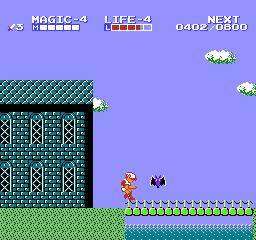
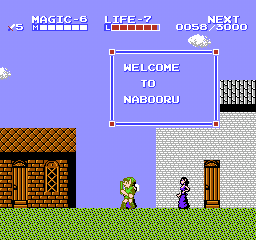
Also, my brother came up with the idea that the monsters could not walk past
the signs into the town. Explaining why there was a sign at the end of the
town as well. Nabooru (ask a 6 year old to pronounce that, I dare you) deeply
confused us, since there was two houses past the sign, and the townspeople had
different lines. What can I say, we were easily amused.
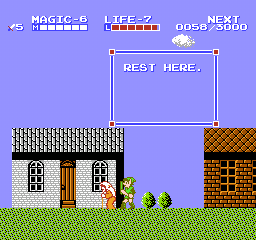
One more thing, that house in the left picture along the right side of the
screen has no roof.

There's no reason for this picture being here.
Sadly, the most poorly implemented JRPG idea put into this game was the exp
scale. It also draws most of the complaints, since the highest levels (which
you need to reach if hope to beat this game) require mountains of exp, and the
overland monsters, even in the last area, don't give much. The 'weaker'
encounter gives a max of 320, while the 'stronger' gives 220. Once you hit the
4000 exp level, the levels increase by 1000 each time.

Once you level up, the counter resets back down to zero, except you do have
the choice to skip a level, raise up something else, and come back to lower
one at a later date. The best place to raise levels is palace 5, the palace on
the sea, but once you beat it (and everyone races to beat the temples), you
can never enter again. If you are not at attack 7, magic 7, life 8 before you
beat palace 5, just reset your game. Seriously. You could get back to that
point in the game and reach those levels before someone raises one level in
area 6 overland. Plus, there are monsters that take away exp, because the game
developers hate you. The worst of the lot is tied between two very frequently
found monsters. The first is these slow moving floating statue heads that
shoot magic beams at you. And they attack in packs of 3 or 4.
It's hard to convey on paper how much these things suck.
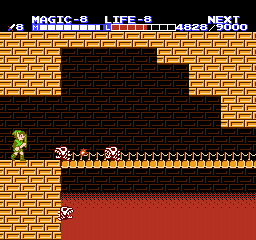
The other monster is these bone fish things that would jump out of lava and
peg you as they flew through the air.
If they missed you and landed on the ground, they would chase after you
shooting stones.
The programmers even stuck those things in the Great Palace, but Shigeru
Miyamoto must have just looked at them and said, "Not good enough, make them
shoot fire."
Still, you have to admire how much Zelda 2 ups the ante every time you think
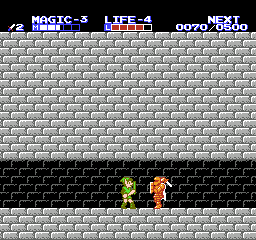
you've got things figured out. First, you fight Stalfos, which can be easily
slain by just kneeling and slashing.
Then, the game throws Inonknuckles at you (yes, they are a different enemy
than Darknuts).
I don't really know what these next things are; they're called 'Goblins.' And
they're also really annoying.
Doesn't it look like it's hiding its genitals from view? Ahem! Then you run
into Stalfos that can jump and downward thrust you.
Then you meet even stronger variants of both Ironknuckles and Stalfos.
I don't have that much to say about Doomknockers, except that I freaking hate
them.
Dairas suck too, reason number 1 to never, ever fight in a graveyard.
Getting back to the subject at hand, that's when the game gets mean and sends
the blue Ironknuckles that can throw their swords at you.
And Just as you think you've seen everything, the Lizalfos (in their first
Zelda appearance!) start showing up, and red and blue ones attack with maces
you can't block without the 'REFLECT' spell and you're left thinking "what the
hell are these things?"
Yes, that's my only picture, and no, I'm not taking any more.
Finally, in the Great Palace, you run into what can only be described as a
night of free-basing gone bad, the combination of the jumping Stalfos and blue
Ironknuckles, the Eagle Knights. They exist for one purpose: kicking your ass.


And they do that very well.
The Great Palace is something else, you see. In newer Zelda games, they take a
megaman-like approach, except for Twilight Princess which finally gives us a
unique final dungeon: "Just stick in rooms that use the exact same puzzles
from earlier dungeons or bring back all the bosses." With the Great Palace, it
more than lives up to its name. Shigeru Miyamoto even lets you continue from
the start of it, because the road to get there is freaking tough, and you're
not going to have any lives left the first time you get there. Then, they
remix regular monsters to have more hit points, do massive damage with every
hit, and shoot fire that can only be blocked with the 'REFLECT' spell.


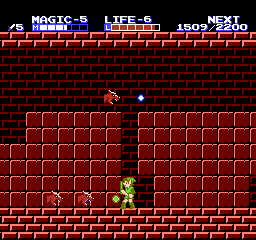
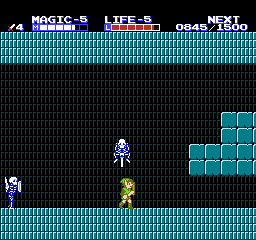
The bots in the picture to left take two hits to kill, with strength level 8.
There's even giant bubbles, that if you hit them and don't kill them, they
break into two fast moving small bubbles that you aren't ever going to hit.
The place is also freaking huge, it's got lots fairies, false walls up the
wazoo, a rare 1-up doll, and not one, not two, but four curtain rooms, just to
fake you out and think you reached the boss room. Plus it has perhaps one of
the best musical pieces ever for the NES.
Believe it or not, the official name of the enemy on the right, directly from
the Legend of Zelda Collector's Edition guide is 'Soprano.' Further proof that
no one in Japan should ever name anything ever again.
You thought I was going to forget about the giant bots, didn't you?
And Now for Something Completely Worthless: the Items
Unlike the every other Zelda game, the items that were found in the palaces
were used automatically, similar to how the raft worked in Zelda 1. For the
sake of convenience, I'm not going to mention heart containers, magic
containers, 1-up dolls, or the story items like the water of life or the
kidnapped kid, because those don't appear in you inventory at the bottom of
the sub-screen.
The Candle
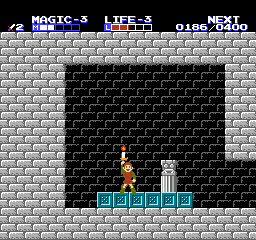
Works kinda like the magic candle in Zelda 1. It allowed to see not where the
pits were, but where the enemies were. Which, now that I think about it, is
the reverse of the candle from Zelda 1. While not necessary to beat the game,
I've never heard of anyone not getting it and going the whole way. Because
they would have to be fucking stupid.
The Handy Glove (Yes, that's what it's called)

It gives Link the power to break the blocks that often fall from the ceiling.
There are also platforms over lava made from those same blocks, with enemies
killed best with downward thrust sitting on them, just to taunt you.

It is needed to beat the game, and it's so damn fun to use.

Whee!
The Hammer
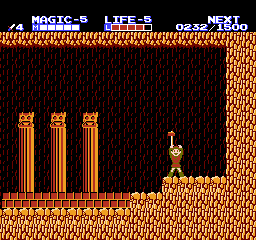
Making its first Zelda appearance, the hammer does the same job here as has
done in every Zelda game since. Breaking large rocks in your way. One of the
two items that is not used automatically. It was also found in death mountain,
not a palace. And if you wander around that small area, you'll notice it is a
nearly exact replica of the Zelda 1's overworld. Proving just how huge Zelda 2
is.
 The Raft
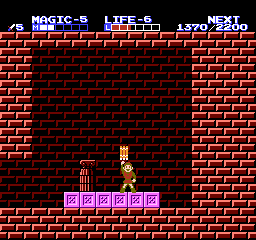
It allows Link to journey to Eastern Hyrule. That's about it. Removed from
later games because Link could freaking swim. Or you could say replaced by
Zora's flippers, and comes back as the boat in Wind Waker, so I guess it
wasn't removed at all. On a side note, it looks like a bunch of matches.
The Boots
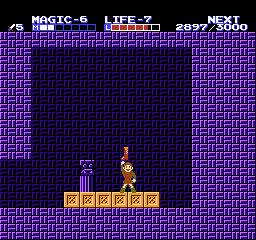
These snazzy boots give Link the power to walk over water. Prompting me to
jump into the first water pit I came across, dieing instantly.
Yes:
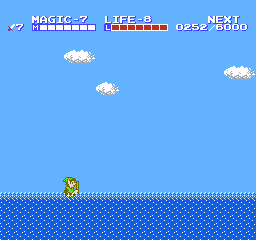 NO:
NO:
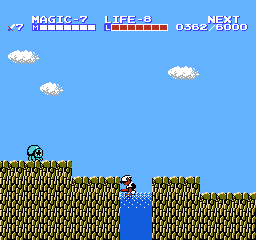
The boots really only gave Link ability to walk on water in a few places.
Namely, getting the hell off Maze Island, getting a heart container, and
reaching palace 5. Later retconned by Nintendo to be the hover boots from
Ocarina of Time. This is just Nintendo pulling a 'Square-Enix' by trying to
make all the Zelda games relate to their biggest success.
The Flute
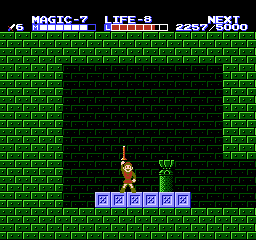
Once again, Shigeru Miyamoto proves he likes playing musical instruments, and
wants everyone else to play them as well. The other item not used
automatically, and used exactly twice. More if you want to piss off anyone
watching you play this game.
The Magical Key

Just like in the first game, the final levels had no keys to be found, but
plenty of locked doors. So there are lots of clues where to finds this item.
No, really, they went way overboard giving clues where to find it. I'm still
finding them. Due to the placement of it, if you downward thrust on it, you
can make Link float. When asked why the spell 'SPELL' should be used to find
it by one of the staff, Shigeru Miyamoto responded, "Because it's mysterious!"
in a creepy voice while flicking the lights on and off.
The Cross

Used to see invisible enemies. You might be able to beat the game without it,
but see the candle above for my view on the matter. It's kind of funny that
Nintendo jumped all over Konami for their 'boomerang' weapon. When this looks
way more like a cross then the Konami's version ever did. Oh, and Nintendo's
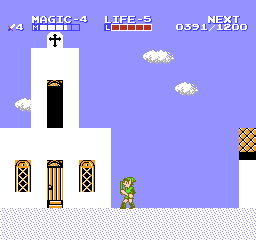
do as I say, not as I do moment #3. Also, for more cross fun, there's one on
the church in Mido town. So I guess this bumps Nintendo's 'we're hypocritical
bastards' count to 4.
 Getting Their Own Theme Music: the Bosses
One of the more interesting things to think about is that in Zelda 2, it
introduced the whole idea of bosses to the Zelda franchise. Yes, there were
large, boss type monsters in Zelda 1. However, these large monsters were
fought several times throughout the dungeons. It was the inclusion of the
side-scroller aspect which allowed the bosses to take precedence over the
dungeons themselves. In Zelda 1, the hardest part of the dungeons were not the
boss monsters, but surviving past room after maze-like room filled with
darknuts, wizzrobes, and like-likes. In Zelda 2, the focus was more on the
bosses, which thankfully, has been rebalanced to focus on both the dungeons
and the bosses in later Zelda games.
Horshead
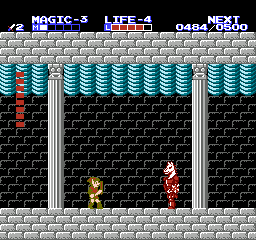
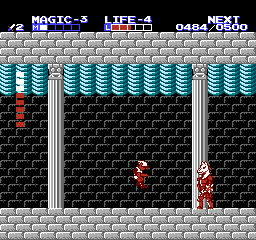
The guardian of the first palace, Horshead is giant wimp. A wimp that can kill
you in 4 or 5 hits if you aren't smart enough to cast 'Shield' on yourself.
All you have to do is jump and swing your sword and force him back so you
don't get hit by his mace. It advisable to never do two things: force him back
against the right side of the screen, since he can still hit you and you can't
hit back. And never cast 'JUMP' on yourself, since that majorly screws up your
timing. Unless you went far forward into the game and got downward thrust.
Then you can just use that on him. Also, my dad once power-leveled his attack
strength to 4 and killed him in two hits. Worth 50 points.
Helmethead
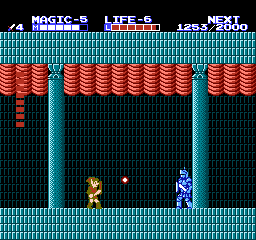
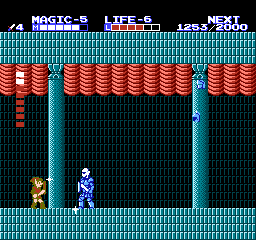
Helmethead starts off similar to Horsehead, but after the first two hits, his
helmet flies off and continues to attack you, similar to Gleeok from Zelda 1.
Also a huge wimp, especially if you have downward thrust. Shigeru Miyamoto
would go on to perfect the Gleeok type boss with Blind the Thief in 'A Link to
the Past'. Who would be one of the coolest bosses ever. Still waiting for a
Gleeok type boss in a 3D Zelda, because you know it will kick your ass. Worth
200 points.
Rebonack
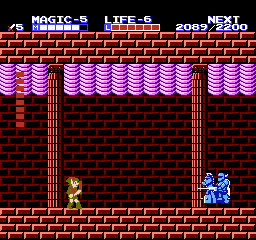
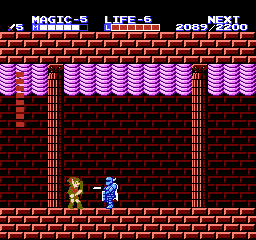
Now we're talking. After two wimpy bosses, Zelda 2 shifts into high gear by
taking the hardest normal enemy you've met so far, the blue Ironknuckle, and
putting him on a freaking floating horse. He then proceeds to grind you into
Link paste before dismounting, refilling his life bar, and fighting you on
foot. Not only there are no walls to pin him against, but pulls the same trick
that horshead pulls: get him to close to the edge of the screen, and you can't
hurt him, but he can hurt you. Comes back to fight you twice in the sixth
palace, because he hates you that much. His reappearance shocked my father,
since he didn't want to beat the boss without getting the item, leaving my
brother to reassure him that the real boss was a "huge dragon thing". Worth
300 points.
Carock
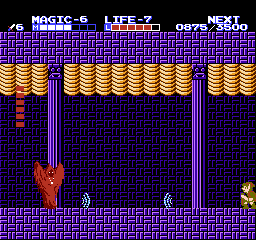
After the intense Ironknuckle boss, not to mention the nightmarish
4
th palace, the fourth boss is a nice breather. All you have to do
is cast 'REFLECT' and kneel until he dies. Of course, he likes to teleport
right on top of you, so it's just a question of outlasting him. Carock can be
considered the prototype of the 'Agahim' type boss, where you have to send his
attacks back at him. Seen here as the only real 'trick' boss similar to other
Zelda games, i.e., hard until you figure out how to beat him. Personally, I
really wish Miyamoto would stop using this 'reflect enemy attack' boss type,
since it appears in almost every Zelda since then, and I'm getting really
tired of it. The first time we got up to him, my father tried to stab him with
the sword. My dad is like that. Also worth 300 points.
Gooma

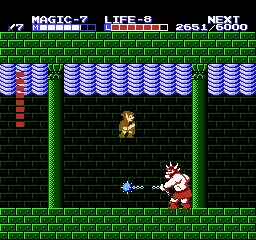
I didn't even know this guy's name until a couple of years ago. I used to call
him 'mace guy' or something along those lines. His one attack is swinging a
huge chain hammer at you. So you cast 'SHIELD' and 'JUMP' on yourself and
start jumping in, striking him, and jumping out. In fact, with the 'JUMP'
spell, you can jump over his weapon. Perhaps the most enjoyable boss to fight.
It also fits the level as well. Palace 5 is like Level 8 from Zelda 1 or Level
7 from the Second Quest. While big, every room is completely filled with
monsters, usually Ironknuckles. A total bloodbath from beginning to end. Still
waiting for that type of level in the new Zeldas, but I guess I'll just have
to settle for the Savage Labyrinth from Wind Waker or the Cave of Ordeals from
Twilight Princess. Worth 500 points.
Barba (I refuse to ever call him Volvagia)
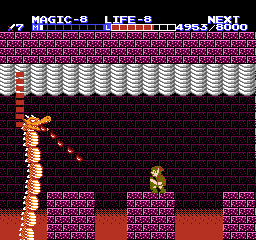
A giant freaking dragon. That's right, it was so huge, he doesn't even come
all the way on screen. The best spells to use are 'SHEILD', 'JUMP' (wait until
after you reach the second platform, or else you fall into the lava), and
'REFLECT'. Arguably the hardest boss so far, since there are three lava pits
in the room that you can die in, and Barba shoots a stream of fire that will
hit you past your shield if you just stand there, knocking back into said lava
pits. You can try downward thrusting him, but there's a good chance you'll
fall into the lava. If you do manage to kill him and die, as long as you have
an additional life, he'll still be dead. Worth 700 points.
Thunderbird
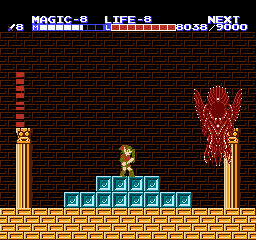
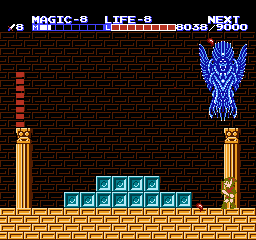
Okay, another boss I didn't know the name of until a few years ago. Like most
NES bosses, the name seems more like random words mixed together than actually
planed out. This boss required the most magic of all: 'SHIELD', 'JUMP',
'REFLECT', and 'THUNDER'. Reducing your magic meter to just 1-and-a-half
boxes. He just floats around, throwing fire at Link. His weak point is his
face, revealed by the 'THUNDER' spell. He is mostly known for giving the most
points (1000) and giving you a completely worthless key.
Link's Shadow
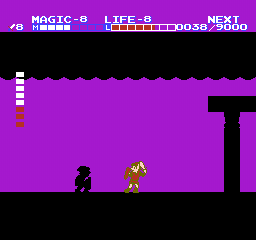
The final boss of the game, and held as the hardest of the all. He is so hard,
that most people prefer just to exploit his A.I. by realizing he can't move
and block low attacks at the same time. Personally, I will never exploit that
weakness; he is too much of a worthy opponent to use cheap attacks on. He will
kick your ass, repeatedly, and I do mean repeatedly until you defeat him. And
defeating him is one of the greatest achievements ever. You might have noticed
that I mentioned my father several times so far. That is because he is the
greatest Zelda 2 player ever. He is the one who defeated the shadow first
between him, my brother, and me. I could go though the entire game without
getting hit and still not measure up to that.
 Thanks a Million: the Ending
In an age where you would only get a 'thanks for playing' message, Zelda 2
tried to give a little more. It's still not much, but I personally thought it
was the greatest ending ever at the time, because Nintendo threw in a hidden
joke for die-hard Zelda fans. After the first Zelda game proved to be a
success, there were cartoons and even comic books made. In them, Link was
always trying to kiss Zelda. And in the ending of Zelda 2, he finally did. I
must have laughed for 5 minutes.
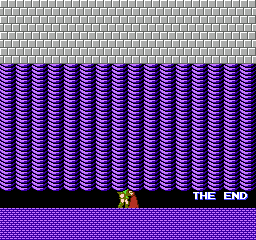
I might have complained lots during this look back at Zelda 2. That doesn't
change the fact that I love this game. I could have gone on about the smooth
play control, or the way that Miyamoto manages to move an over-head game to
side-scroller and still keep the monsters that we loved, like moblins,
octoroks, and goriyas recognizable. The Zelda franchise still didn't have the
puzzles during this game that made it famous, just maze-like dungeons. It was
a risk, taking a beloved game and doing something completely different with
it, and that just doesn't happen anymore. While the game was a huge success
when it came out, now it is barely regarded as a Zelda game. I think that's
why game developers don't mess with winning formulas too often, because fans
are way too finicky, if a sequel doesn't exactly play like an earlier game, it
is regarded as a failure.
Still, it is very hard to tell people that they should go out and play this
game. Almost everyone who defends this game points out how much this game gave
to Zelda franchise. It doesn't change the fact that other Zelda games include
these features better, like the magic meter. In fact, Twilight Princess throws
out the magic meter, and I realized how much I hate that freaking thing. So
what it was the first game to feature the hammer? You couldn't use it to smash
enemies. So, maybe it's just me being a Zelda fanboy at heart to never really
give up on this game.